36 Lessons
THE ART OF THE INFINITE PIVOT
FUTURIST JIM CARROLL
"Success isn't reaching a destination; it’s mastering the art of the infinite pivot."Follow the journey at: pivot.jimcarroll.com
I walked out of the corporate world 36 years ago to bet on a home office, a fledgling new technology known as the Internet, and a belief that the future belongs to those who can change.
I’ve learned a lot along the way! Through those years, I’ve survived market crashes, massive technology revolutions, and the beautiful chaos of raising a family in the same rooms and homes where I wrote 44 books. All along the way, I’ve learned what it means to pivot — to change my career focus, reinvent my skills, adjust my personal outlook, rebalance my time commitments. Every single time, I was somehow pivoting, changing, and adapting.I meant to share these lessons at Year 35 — I wrote a long post last year with some thoughts on what I’ve learned. I haven't shared it yet —I wanted to get the lessons right.But the other day, I stumbled across it and realized I had powerful insight to share. Many people around the world are in the early years of the freelance economy; it might be useful. Given how quickly AI is evolving, there will probably be more.With that in mind, I’ve distilled my journey into this new series: The Art of the Infinite Pivot.I’ve come to realize that the delay was actually part of the journey. In a world obsessed with “instant” and “real-time,” I’ve learned that the best insights are the ones that have been lived, tested, and breathed for decades.Over the next few months, I’m going to share them one by one — not as a “guru,” but as someone who has spent 36 years in the trenches of the home office and global freelance economy. Whether you are a solo-entrepreneur, a corporate leader considering t a pivot, or someone just trying to build a new future, I hope these lessons help you navigate your own voyage.Follow the journey at: pivot.jimcarroll.com
#1: "The greatest ROI is time."
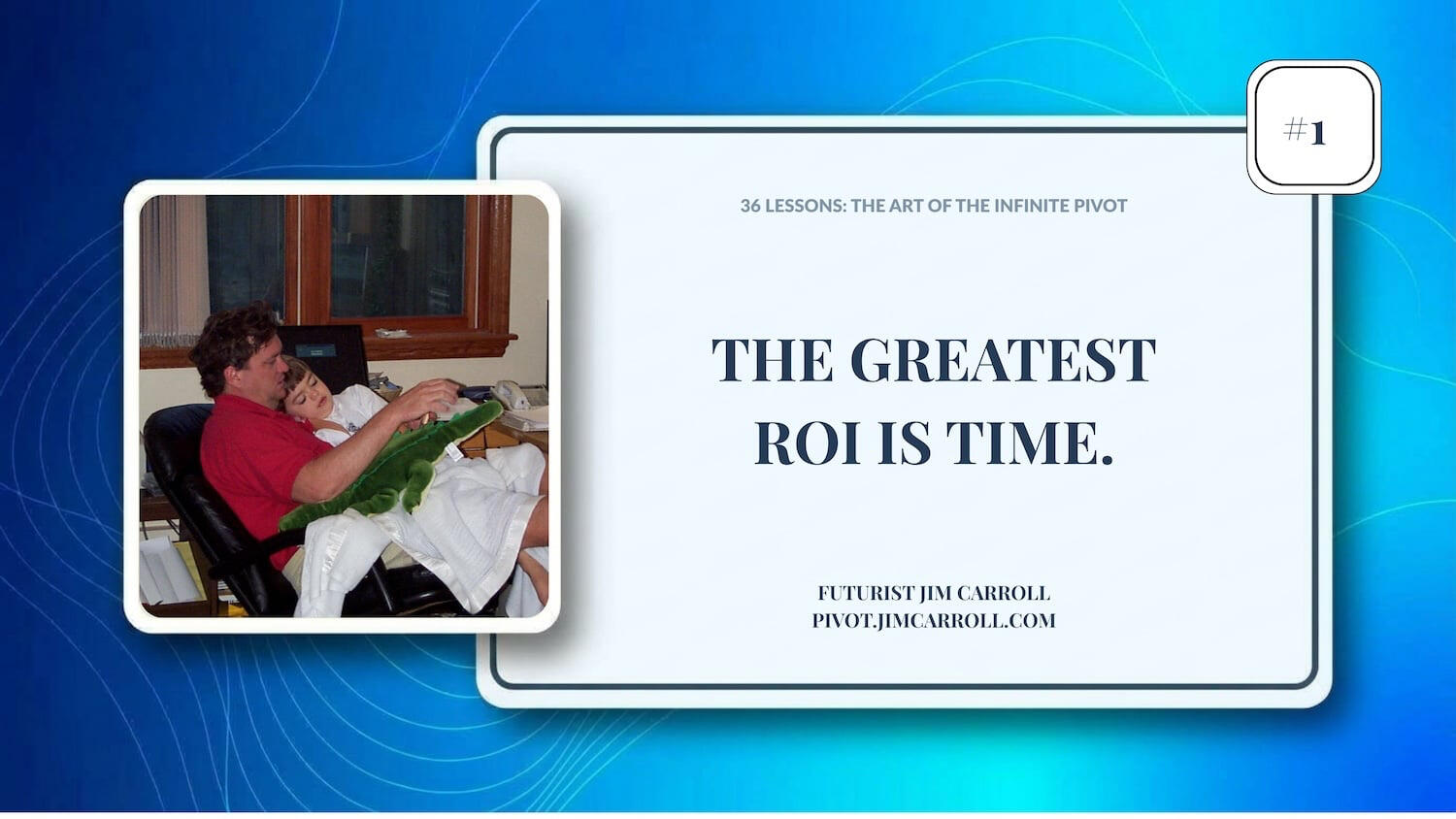
Through 44 books and thousands of keynotes, I have chased many things: innovation, market trends, and technological velocity. But looking back from Year 36, the most successful pivot I ever made wasn’t financial or professional.It was the pivot toward focusing on my family.
Thirty-six years ago, I made a choice that many are facing for the first time.I stepped out of the corporate world to bet on a home office, emerging trends, and a belief in myself. Seven years later, I began writing about this shift as a major trend, identifying the rise of “nomadic workers” — people we now call members of the freelance economy. In 1997, I published articles and a book (never completed) outlining the vanguard of a new economy where the traditional “job-for-life” was being replaced by a portfolio of skills and a freelance attitude.Through 44 books and thousands of keynotes, I have chased many things: innovation, market trends, and technological velocity. But looking back from Year 36, the most successful pivot I ever made wasn’t financial or professional.It was the pivot toward focusing on my family.In this high-speed global economy, it is easy to become a slave to the “next big thing.” It’s easy to chase the never-ending quest for career success. It’s easy to lose yourself in all the opportunities that are swirling around you.But the reality of a meaningful life is that the greatest ROI is always time. You will never look back and regret the hours you invested in your family instead of the greater career success you might have had.To make my freelance voyage of nearly four decades work, I had to be disciplined. Over time, I developed a set of “10 Rules for Working at Home” to protect that time, and wrote them into a post in 2002. My favorite is Rule #10: “Remember why you are doing this. You’re working at home to be with your family. Don’t let the work get in the way of that!”I remember a crucial call years ago where my two-year-old son came running into the office screaming because he’d banged his finger. I was frantic, trying to maintain my “professional” corporate persona. The woman on the other end just laughed — she was working from home too. In that moment, the “nomadic worker” reality hit home: the “interruption” isn’t a bug in the system; it’s the primary feature.If you are navigating the freelance economy today, don’t hide the chaos.Embrace it.Make it a part of your voyage.Design a career that flexes around life, not a life that shatters when work gets busy.The journey continues tomorrow. Are you ready for the next pivot?
#2: "Stop treating perishable expertise as permanent knowledge."
When I walked out of the corporate world in 1990, I carried a set of skills I thought were permanent.I was wrong.I quickly realized that in the freelance economy, knowledge is the foundation, but expertise is an asset that quickly fades. I learned pretty quickly, when it comes to the art of the infinite pivot, that if you aren’t actively enhancing and renewing your expertise, you aren’t standing still- you’re falling behind. Think about that – knowledge is what you know.
Expertise is how you apply it. And if core knowledge keeps changing, your expertise keeps becoming outdated. You need to rapidly and relentlessly pivot.And core knowledge is certainly changing. In the 36 years since, I’ve watched the “half-life of knowledge” shrink from decades to months. Everything I was writing about, speaking about, and advising about was undergoing relentless change. Today’s keynote became tomorrow’s legacy talk. Between 1994 and 2001, I wrote 34 books on the early Internet, and each one of those was very different from the last as the technology and applications kept changing. I had to continuously and relentlessly learn just to keep up.That high-speed execution taught me a brutal truth: the moment you stop reinventing what you “know,” it ceases to be an asset and starts becoming a liability. I didn’t just have to write fast; I had to “unlearn” even faster.Today, we’re witnessing even faster change with AI. What you know at this exact moment in time will probably be irrelevant tomorrow.I carry this story with me all the time. I’ve spent three decades telling global audiences that wealth is no longer found in what you know, but in how fast you can learn. I live this idea – in my home office, curiosity isn’t a hobby: it’s a core business process. I can’t afford to be a “specialist” in a world that keeps changing the specialties. That’s why any time I have a bit of downtime, I spend a chunk of it learning new stuff. The last few weeks have seen me wildly immersed in the vast new sophistication of the Claude AI set of knowledge tools because something profound is happening here. I can’t explain what I don’t actively use.What does this mean? Today, as AI moves at “ludicrous speed,” this lesson is the only thing keeping nomadic workers relevant.The Infinite Pivot requires you to treat your current skills as temporary tools.Use them, master them, but never assume they are permanent.
#3: "Waiting for total clarity is the fastest way to become irrelevant"
When I walked out of the corporate world 36 years ago, I thought I needed a five-year plan.That’s actually kind of funny to think about now.I quickly realized that in a world of high-velocity change, a five-year plan is certainly on the list of things that won’t happen! I came to learn that the real danger I faced wasn’t a bad plan; it was what I’ve come to call the Clarity Trap. That’s the belief that you must see the entire path before you take the first step!
Since then, I’ve spent three decades watching the brilliant leaders and organizations become caught in the trap. I’ve seen them paralyze their future because they were “waiting for the dust to settle,” for the path forward to become clear, for the future to be more certain. And they end up waiting a long time. All the while, they think they are being diligent, but as they wait for the “perfect” view ahead, the landscape they were studying has already shifted.Whether you are running a global corporation or a solo practice, if you wait for 100% certainty, you are already too late.I didn’t have a map for the last 36 years; I believed the trends I was watching were going to unfold into something bigger. When I dove into the early Internet in 1994, the technology was messy, and the business models were nonexistent. Yet I didn’t wait for clarity; I gained clarity by moving.The Infinite Pivot requires you to execute on partial data, imperfect information, and a stunning lack of focus. You have to be willing to move when the clarity of the future is still uncertain — and be prepared to adjust your course mid-flight. This is particularly true when uncertainty dominates and volatility rages. Your only real protection at this point is momentum. If you are moving, at least you can steer. If you are standing still, you are just a target for disruption.This reality becomes even more challenging in an exponential world. The “safe” move of waiting for more information is actually the riskiest move you can make. The only way to find out if a pivot works is to make the turn.Stop waiting for the “right” time.The right time is the moment you realize that standing still is a choice to be obsolete.
#4: "Remember that prolific can beat perfect."
Here’s something I’ve learned firsthand: the world doesn’t always reward the best idea. It often rewards the one who shows up most often.And did I ever show up!Between 1994 and 2001, I entered a phase of intense, high-speed execution. I wrote or co-wrote 34 books, hosted 3 radio shows, wrote a national newspaper column, contributed to many other publications, and did hundreds of media interviews. The books? That was an average of nearly five books a year — all at the same time that my wife and I were in the midst of welcoming two babies into our lives.Many people asked how I could maintain that pace while raising a family in a home office.
The answer was simple: the opportunity (the rapid emergence of the Internet and global connectivity) was there, and I decided to chase it. In retrospect, I guess I treated my output as a manufacturing process. I didn’t wait for inspiration; I focused on delivering insight at an industrial scale.In any industry or career, your capacity for consistent, high-speed execution is the single greatest predictor of your long-term success. The simple, daily act of showing up and doing the work defines your potential. Whether you are developing software, launching new products, or building a brand, velocity is your competitive advantage and execution is your differentiator.Why is that? If you are producing at ten times the rate of your competitors, you are learning ten times faster; you are developing critical insight quicker; and most importantly, you are failing ten times faster. What does that lead do? When the world continues to change, you pivot ten times faster!Some folks call this “hustle culture.” It’s about the realization that in a fast-moving economy, the opportunity in front of you has a short window. If you take three years to release a project, the world has already pivoted twice by the time you launch. By the time my 34th book hit the shelves, I was already moved on with my next career pivot, focusing on the link between innovation and the future.What’s the lesson in all of this? Don’t over-analyze your voyage! Move from the “think-tank” of what you can do and why you can do it to the “production-line” of getting things done. As they say, just do it!Because sometimes focusing on the output of where you are going is better sent than trying to ingest all the input of where you could be going.
#5: "Never let your fear be the barrier to your future!"
When I walked out of my corporate job 36 years ago, I was terrified.I didn’t yet have a mortgage, but my wife and I were newly married and planned to get one soon! I had no certainty that my idea of going freelance would work, and I was pretty scared I might fail. All the while, I was reminding myself that while my career path inside a big global firm was “stable” on paper, I was miserable every single moment.I had to get out, but my fear told me to stayLooking back, I now realize that confronting my fear is a natural part of my career pivot.
I went through this fear issue again and again as I continued to pivot. I’d see the need for a change and developed a fear of what it represented. I pushed through regardless. Confronting fear became a critical part of my process.Throughout this time, I also learned that fear was often a guiding and prevalent issue within my client base when my solo career pivoted from a pure technology focus to innovation & the future.Innovation? I’ve regularly seen that the biggest obstacle to innovation isn’t a lack of budget or lack of ideas; it’s the collective fear of the unknown. People stay in shrinking markets and outdated roles because the “known” misery feels safer than the “unknown” opportunity. They allow their fear of making a mistake to become the very barrier that prevents their progress.Trends? When it comes to the future, I’ve learned that vast numbers of people live in fear of what it represents. Trends change careers, disrupt industries, challenge competitive thinking — they cause havoc! And many people, looking at that havoc, recoil in fear of what it represents. The result is they choose to ignore, belittle, or deny the trends. The very fear that drives this reaction causes them to miss the opportunities the future provides. This often means that their fear becomes the root of a misguided prophecy!But here’s what I also know: confronting fear is a critical part of the pivot process. For me, every breakthrough — from writing my first Internet book in 1994 to pivoting into virtual keynotes and now AI — started with a moment of profound discomfort that was often fear-based. And the fact is, had I let that discomfort dictate my decisions, I would have never achieved much! The Infinite Pivot requires you to acknowledge the fear, but refuse to let it take hold of your future.Whether you are a leader navigating a shifting industry or a nomadic worker reinventing your skills, you have to realize that the risk of standing still is far greater than the risk of moving forward.Never let your fear hold you back – let it guide you.
#6: "Trade security for opportunity."
You’ll never pivot if you don’t take on the risk!When I trying to decide many years ago if I should leave the corporate world and become a freelancer, , my fear told me I was trading a “sure thing” for a “wild gamble.” My colleagues thought I was leaving a safe harbor for a volatile ocean. Even before that, they were busy hammering home to me that I was making a mistake by abandoning the safe world of accountancy for some unknown career emerging in global connectivity.But I also knew that something big was happening, and I wanted to be a part of it. I traded my future security for the opportunity that lay in front of me.
That taught me a valuable lesson that not only guided me throughout my career, but also became core advice for my corporate clients. And in fact, three decades of advising global leadership teams have taught me a brutal truth: the gamble isn’t the pivot; the gamble is staying put.As someone who speaks and writes about disruptive trends, I’ve watched far too many “safe” industries dry up and “secure” corporate giants crumble because they were anchored to a past that no longer existed. They refused to take on bold new risk in order to chase disruptive opportunity. And in a high-velocity economy, here’s wahat we know: focusing on certainty is the wrong thing to do.The fact is, if you are anchored to a static model, you aren’t safe.You are a stationary target for disruption.True security doesn’t come from chasing safety; it comes from the agility you build when you choose to navigate change. The wrong path is the one that promises safety because it’s often a dead ernd.The right one – the one that involves risk and uncertainty – is the that one that usually offers growth.
#7: "Don’t let your past define your future."
In the late 1990s, I was at the top of my game.I had written 34 books and was the go-to expert for the “Information Highway.” I literally did thousands of interviews with the media – and can still find many of them online. On paper, in print, and in broadcast, I had ‘arrived.’I did so many interviews that for a long time, I was pegged everywhere I went as ‘that Internet guy.’ And yet, when the dot.com collapse happened around 2001, many people thought the disruptive impact of the Internet had come to an end.So too did my career – the result was that my bread and butter dried up. People no longer wanted ‘Internet strategy.’ They wanted the next big thing, and that ‘big thing’ was a broader range of trends and disruptive innovation.
Since I was spending all my time on stages and boardrooms speaking about those issues, albeit with a technology and Internet focus, I decided I would be a “Futurist, Trends & Innovation Expert,” a self-anointed title I carry with me to this day. That’s when I came to realize that the “Infinite Pivot” isn’t a one-time event.Why did I shift? By 2002, I realized being “The Internet Guy” was a brand with a shelf life. The world was moving from how to use the web to what the world would look like next. I had to do something uncomfortable: abandon a successful brand to build a significant one. I documented the story here, observing:But then came the path he would never have predicted. Although today there are actual courses and schools dedicated to futurism, like the Futurist Institute, Carroll found his vocation quite by accident.It began when he fell into the orbit of a Vancouver man named Frank Ogden, a renowned futurist who went by the name Dr. Tomorrow, and the two did some gigs together. Ogden’s career was winding down, and Carroll, who was already talking about future trends in the context of technology, saw an opportunity to pick up the mantle.At the time, it felt like a massive risk to leave the security of a known niche. But by choosing my own title, I was claiming the future. I stopped being defined by the tools I explained (the Internet) and started being defined by the perspective I provided (the future).I was NOT letting my past define my future. Just as I refused to let my accountancy career and designation define my technology role. (I’m still, at this moment, a CPA! I just don’t talk about it much!)And wow, was this pivot a success!It took hard work but from about 2005 to this day, I’ve built an entirely new career with an entirely new brand. And in this is a critical lesson for any organization: you might be the market leader today, but if you allow that success to define your identity forever, you will become a legacy act.True agility requires the courage to “self-title” into your next phase before the market forces you to.
#8 "Every successful pivot requires a silent partner"
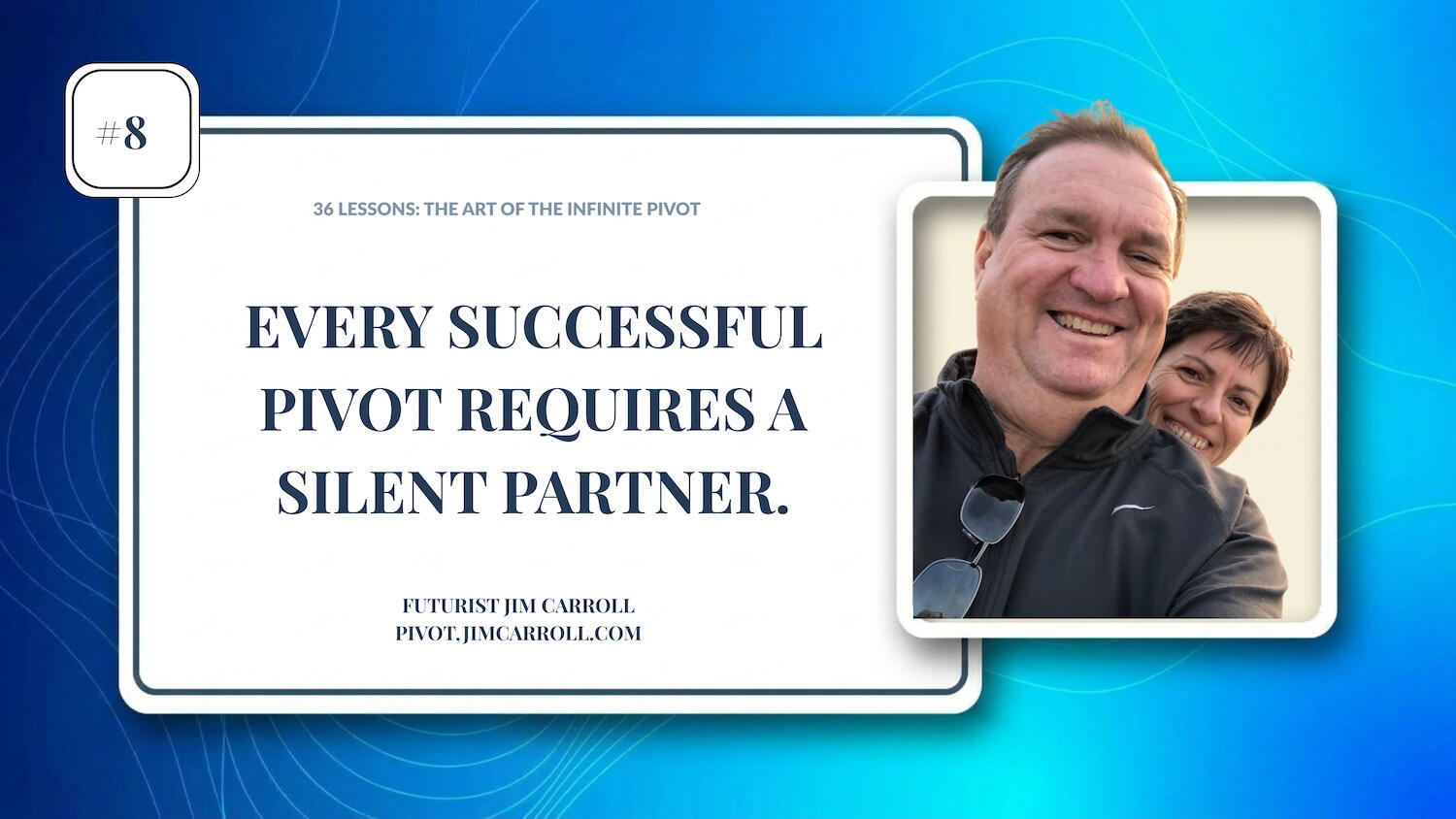
For 36 years, I’ve been the one on the stage, the one with the "Futurist" title, and the one writing the books.But none of it would have been possible without my wife Christa. When I walked out of my job in 1990, we were in it together. I was tired of the corporate world and wanted to chase the future - she had a stable and lucrative executive position in a global multinational and could help to finance the risk.We decided - together - that I could take the plunge - into the world of technology consulting.
Then, as I pivoted to the Internet in '94 and then to the "Futurist" role in 2002, she wasn't just supporting the move. She was the rock of stability that allowed the move to happen, all while raising our two young children. But she wasn't just the mom - she was the matter organizer of complicated logistics, contracting, and so much more. Oh, and at the same time, she was the rock-solid editor of the (soon to be) 44 books that I have written or co-written throughout my career.I've written about her role before, and in one post, referred to her as the 'Fifth Beatle' - the George Martin of the operation, the Bernie Taupin partner, the one whose role is often unseen but absolutely critical to the overall success.
Look, I am not professing to be someone who has the creative brilliance of the Beatles, or the musical mastery of Elton John – but they had George Martin, the producer, and the Rocket Man had Bernie Taupin, the songwriter.Both working, mostly silent, behind the scenes, who do the truly magical things to make creativity magical!And I have my Christa.
In the world of the Infinite Pivot, everyone talks about the effort involved in changing. They focus on the speed, the risk, and the vision of the person at the helm. The key person, so to speak.But they forget that if you try to pivot without a solid foundation, you don’t manage to succeed. Often, you just spin out of control. Christa has been my business partner, my office manager, and my reality check for nearly four decades. She provided the structural and emotional "anchor" that gave me the freedom to be bold, all while raising our sons.It's an invaluable lesson, and one that scales from the home office to the global boardroom. A corporation cannot successfully pivot its business model if it doesn't have a stable core of values, a resilient culture, or a dedicated team providing the foundation for that change. You need a "silent partner," whether that is a person, a process, or a set of unwavering principles, that stays steady while everything else is in flux.You need a rock.The boldest moves aren't made by those who have nothing to lose; they are made by those who have a solid place to stand. Before you make your next turn, make sure you know who, or what, is holding the ground for you.In my case, it's Christa.
#9 ""Remember that many opportunities are often found out on the edge"
If you want to know where your next pivot is coming from, stop looking at the center of your industry.Look to the edges instead.Why is that? The center is crowded, safe, and focused on yesterday’s success, and that fact often means that not much innovative, disruptive thinking is occurring there.
To pivot is to chase new opportunities, and I’ve followed that reality: throughout my 36-year voyage, every major shift I made, from the Internet in ’94 to AI in ’26, was found by looking at the outliers on the outskirts of the mainstream.1994 and earlier? The “serious” business world dismissed the Internet because it looked unpolished and unprofitable. It was an anomaly on the periphery. But I wasn’t looking for “safe“; I was looking for the unique opportunities this rapidly emerging world of global connectivity provided. I realized that the people on the edge were building a new reality while the people in the boardroom were busy defending an old one. (The telecom world of the time, a true dinosaur, had a vastly different view of how the future would unfold, one which they dramatically and fully controlled.)To make the pivot, I had to stop trying to fit in with the “standard” view of tomorrow and start to follow an unconventional path.I chased many similar future opportunities in the same way, which led me to realize that much of what is involved with ‘edge-thinking’ makes you someone with a unique viewpoint. Today, that has led to my forthcoming book, Being Unique, which takes a look at how ‘edge thinkers‘ approach opportunities. Uniqueness? It’s not just a personality trait; it’s a competitive research strategy. Whether you are an individual reinventing your career or a CEO repositioning a global brand, you have to develop an ear for signals on the periphery. These are the small, quiet developments happening far away from the “proven” markets or the ‘expected‘ future.The standard worldview is designed for stability, but the edge is designed for experimentation. If you wait for a trend to be “proven,” you’ve already missed the window for a high-value pivot.You have to be willing to leave the comfort of the “known” and spend time out on the edge.Because that is often where the future happens.Look for the ideas that your industry currently ignores or dismisses.Because that is exactly where your opportunity is hiding.
#10 “Never forget that adaptability outranks experience.”
The future doesn’t care about your resume.It only cares about your ability to adapt.Don’t let your experience become the baggage that holds you back.If you think about our world of rapid change, you can easily appreciate that experience is a double-edged sword. It gives you the confidence to go forward, but it can also hold you back by encouraging you to be complacent, trying the ‘same old things’ instead of trying new things.
In my 36-year voyage, I’ve come to realize that the more you “know” about how something works, the harder it is to see how it is about to change.Think about it this way: the experience that you have in adapting to change has become more important than experience itself.What does this mean? To master the art of the infinite pivot, you have to be willing to fire yourself as an expert every few years and reinvent yourself. You need to be willing to trade your “Expert” badge for a “Beginner” badge, admitting that the knowledge that made you successful yesterday might be the very thing that makes you obsolete tomorrow.This is not only a personal skill but also the ultimate test for any leader in an era of disruptive change. Most organizations are run by experts who are conditioned to protect their “proven” success. When disruption occurs, these experts are often the first to dismiss it, discount it, and label it as unimportant because it threatens their identity, status, and power. They aren’t just protecting the business; they are protecting their status.To master the Infinite Pivot, you must be willing to unlearn and relearn. You have to be comfortable being the student in a room full of people who have less “experience” but more “adaptability” than you do.Think of it this way: the future rewards your ability to learn, not your ability to remember.Don’t let your years of experience become years of baggage!
#11 “Regret is far more expensive than failure”
Most people and organizations are paralyzed by a single, haunting question: “What if I fail?”They spend months (sometimes years) conducting risk assessments and feasibility studies, all designed to protect themselves from the sting of a mistake. They personally try to avoid risk, or in the case of companies, have entire risk management teams, whose goal is to minimize and eliminate risk. They insulate themselves from bold moves because they cannot bear to see things go wrong.And in doing so, they miss out on a lot of opportunity – and come to regret it later.
What’s worse? Trying to do something and seeing it go wrong? Or thinking back years later, “I should have tried to do it!”In my own 36-year voyage, I’ve learned that the most dangerous risk isn’t the pivot that goes wrong: it’s the pivot that never happens. We need to stop obsessing over the cost of a “miss” and start focusing on the only question that truly matters: “What if I never try at all?”Think of it this way: failure is a temporary setback but a valuable asset. You can learn from it, adjust, and pivot again. But the idea of never trying at all results in a permanent loss of potential. You don’t learn and become stuck where you are, missing out on the chance to go where you should be going.I’ve sat in boardrooms with legacy companies that are now obsolete, not because they made a bad bet, but because they were too afraid to place a bet at all. They chose the “safety” of the status quo, only to find that the status quo had moved on without them.The Infinite Pivot isn’t about being fearless; it’s about being more afraid of standing still than you are of moving forward. When you look back at your career or your company’s history a decade from now, you won’t remember the small stumbles.You will only remember the doors you were too scared to open.Remember: the risk of the unknown is manageable.But the cost of “what if” or “if only” is infinite.
#12 - “Chase the BIG things!”
When big, bold opportunities are unfolding, do you chase the big ideas or keep doing small things?The art of the infinite pivot involves the former, obviously, not the latter.Big trends involve big opportunities, but only come around so often. So why would you wait?Think of it this way: the biggest pivot of your life won’t start with a spreadsheet or a market report.It starts when you finally choose to listen to the quiet, internal voice inside you telling you to leave the safety of “certainty” for the risk of something bigger.
When I quit the corporate world in 1990, I didn’t have a 50-page business plan. What I had was a gut feeling that something massive was happening with global networking. I just knew I had to be a part of it. I had no idea where it was going to take me, what I might do, or how I might shape my tomorrow. But I just knew… so I traded a predictable salary for the unpredictable thrill of the unknown.I stopped chasing the “safe” path and started chasing the thing I actually wanted to chase.It worked out pretty well!Unknown to me at the time, I was deeply caught up in one of the most important aspects of innovation of all – emotional commitment to a bigger trend. And that is the lesson many leaders miss: true innovation requires an emotional investment in a bold future. You’ll only accomplish big things if you innovate within the bigger trend.My early pivot has continued through my career. In fact, throughout my 36-year voyage, the moments of greatest growth always happened after I abandoned the “proven” model to follow a bigger signal that only I could hear.Look, certainty is comfortable, but being bold takes you further.Don’t wait for the world to permit you to change.Listen to your internal voice.Chase the thing you want to chase. Because it might be in front of you right now.
#13 - "Let relentless optimism define your core!"
On a milestone like today, you realize that the most important piece of “gear” you’ve carried through 36 years isn’t a laptop or a library of data.It’s your outlook.In a world of relentless change, volatility, and a staggering rate of change that always seems to directly impact you, the most radical mindset you can adopt is to stay relentlessly optimistic.
Optimism isn’t about being naive; it’s about being strategic. It’s about making a conscious decision that you are always going to try to find the upside, instead of obsessing over the downside. You are going to find the opportunities rather than becoming distressed about the negatives. It means you are going to always act to keep moving forward, even though personal circumstances seem to be trying to drag you backward.And it always involves thinking about a potentially better future. Look, if you don’t believe the future can be better, you won’t do the hard work required to pivot toward it. In my voyage, I’ve seen that the cynics are usually right in the short term, but the optimists are the ones who build the long term. Cynicism is a destructive force: optimism is a powerful flex.This is the secret to longevity. When you choose optimism as your core, every disruption becomes an opportunity rather than a threat. Throughout my 36 years, the pivots that felt the most effortless were the ones fueled by a genuine excitement for what was coming next.If you let fear define your core, you will build a career based on standing still.Doing small things. Making small steps. Chasing small goals.But if you let optimism define your core, you build a career based on possibility.Big ideas. Big trends. Big opportunities.As I stand at this milestone today, I’m not looking at the challenges that exist around me today.I’m looking at what comes next and what I will do to be a part of it.That being the case, think about this: the future belongs to those who are excited to meet it!
#14 - "Make difficult decisions sooner.
(Even when you don’t want to)"
At one moment in time, I had Google Claude analyze the thousands of blog posts I’ve written since 2002, to try to come up with a list of the unique phrases I’ve come up with through the years. It came back with a massive list. and called them “Jim’isms.” I’m pretty proud of the list, since these phrases often capture the essence of the ideas I share with my clients and readers.The one I am proudest of is probably the one with which you are most familiar: “aggressive indecision.” I coined it back in 2002 to describe the tendency among my clients to make the tough decisions that need to be made, particularly when uncertainty reigns.And it led me to believe that the most dangerous words in any business or life are, “Let’s wait and see.”
When we wait, we fail. We might tell ourselves we are being prudent, being cautious, but usually, we are just being hesitant. In my 36-year voyage, I’ve learned that the difficulty of a decision doesn’t decrease with time: it only compounds. To stay ahead of the curve, you must learn to make difficult decisions sooner, especially when you don’t want to.Every successful pivot I’ve made in my career and business required me to cut ties with something comfortable but declining. Whether it was walking away from a stable career path or sunsetting a keynote topic that was still “doing okay,” the hardest part identify8ing what I needed to do. It involved actually doing it.As humans, we are engineered, it seems, to avoid the tough decisions. And yet often, that’s the only way to get ahead!The simple fact is this: if you wait until you are forced to make a decision, you aren’t pivoting; you’re reacting.Making decisions sooner -m even when you don’t want to – is the antidote to aggressive indecision. Most organizations and people stay stuck because they treat difficult choices like a burden to be avoided rather than a strategic advantage to be seized. By making the tough call early, when you still have resources and momentum, you control the future to the extent you can. If you wait until your hand is forced, the market (or the crisis) controls you.The Infinite Pivot requires the stomach to act on incomplete information. It means acknowledging that “safe” is often just a slow way to lose. It involves making decisions – even the gough ones – despite every bone in your body screaming to wait.Don’t let the weight of a difficult choice paralyze you.Make the call.The relief of moving forward is always better than the anxiety of waiting.
#15 - "Waste time on frivolous things!"
Here’s something you need to think about if you are considering a pivot in your career or business: the next big thing often starts looking like a toy.When big shifts happen, the world usually misses them because they look like hobbies.
The Internet? People were hanging out on clunky “bulletin board systems” just to chat online. Most people looked away while a global, disruptive communications network was being born. Farmville? Critics see kids wasting time on a digital farm. The reality? Those kids are learning the real-time resource management skills needed to run the autonomous, 24-hour farms of the future. How about Minecraft? It looks like digital LEGOs, but a whole generation is learning how to develop sophisticated, interconnected infrastructure for the smart cities of tomorrow.Or take drones. What started as a “toy” in a park has become the foundation for a revolution in precision agriculture, building inspection, autonomous logistics, and the future of war. How about crypto “gamers“? A decade ago, they were “wasting” money on digital skins. Today, they are the architects of a decentralized finance system that is rewriting the rules of global banking.Then there are folks all around you playing with OpenClaw and other AI systems. Skeptics see people talking about ‘relationships’ with their agents, but the fact is, they are busy building one of the most powerful collaborative tools in human history. Then there is the world of social media: Early critics dismissed it as a fad. They missed the signal, though: online influencers were building the real-time attention economy that now dictates every brand’s survival.Need I go on?In every single case, frivolous, fringe activities emerged on the edges but exploded into the mainstream, resulting in massive disruption – and HUGE opportunities.That’s why you need to know this simple fact: if you are doing a lot of frivolous things, you aren’t wasting time; you are building expertise. You are learning the rules of a new game while everyone else is still playing by the old ones.But here’s the thing: most corporate cultures are designed to kill this “wasted” time. They want efficiency, ROI, and measurable outcomes. But in my 36-year voyage, I’ve discovered that the most valuable pivots always start as “frivolous” experiments. If you only spend time on things that are “proven,” you will only ever achieve what has already been done.To find the future, you have to be willing to play with the things that the rest of the world dismisses as toys.In my case, in the early 90s, I spent thousands of hours on obscure BBS boards, clunky early web browsers, and bizarre, often strange online communities. To a casual observer and many of my coworkers, I was wasting my time. (They often told me so!) But I ended up building an entire career out of my earlier playtime. Think about that – to the “serious” business world, I was playing with a toy. But that “frivolous” curiosity was the foundation of my entire career.I wasn’t wasting time; I was building fluency in a world that didn’t exist yet.This is one of the most important secrets to the idea of the Infinite Pivot – finding new trends regularly and shifting to the opportunities those trends present. To succeed, you have to carve out room for “unproductive” exploration. Whether it’s self-hosting a complex home lab with a highly automated home, tinkering with ESP32 microcontrollers for a garden sprinkler system(yup, I’m currently doing that!), or deep-diving into the latest “weird” AI model, these aren’t distractions.They are the training grounds for your next transformation.Innovation has a playful heart. When you stop “wasting time” on things that pique your interest, you stop growing. You become a prisoner of your own narrow mind.The most important insights are often hiding in the things that look like fun.Permit yourself to be “unproductive.”Play with the weird stuff.Waste some time.It might be the best investment you ever make!
#16 - "Invest in your own experience. Do the work."
Yesterday, I told you to waste time on frivolous things.I encouraged you to play with the “toys” that others dismiss, because that’s where the future hides. But once you find a “toy” that hums with the signal of a major disruptive trend, you have to make a choice: do you stay a spectator, or do you become a practitioner?The Infinite Pivot requires you to move from “playing” to “doing,” and in doing so, developing the critical skills and insight you need to successfully pivot into your next version of you.t
A key philosophy I’ve followed throughout my 36-year voyage is that if I’m going to speak or write about a disruptive trend, I’ve got to have hands-on experience with it. I refuse to be a “slideshow strategist” who simply repeats what they read in a trade magazine. If I haven’t touched it, I don’t feel I have the right to talk about it.It’s one thing to see the “frivolous” potential of a trend; it’s another to understand its soul.So with that being the case, I learn through doing.Linux as a foundation? I didn’t just read about it; I became a Linux geek, building and managing the very server infrastructure that powers my digital presence. Smart home trends? I didn’t just buy a hub; I built a living laboratory of interconnected sensors and complex logic. Self-driving cars? I didn’t just watch the videos; I invested ten grand in Tesla’s FSD. (The hands-on “phantom braking” moments taught me more about the reality of AI than any white paper ever could, and the fact it won’t be real for quite some time. DNA-based preventative medicine? I didn’t just track the news; I had my 23andMe done and took a deep dive into my personal healthcare genome to see the future of personalized wellness firsthand.Do you get the point? I can’t go on stage and speak about future trends if I don’t have a deep, visceral understanding of those trends.In an era of shallow, AI-generated summaries and surface-level takes, your greatest competitive advantage is tactile truth. While everyone else is talking about the future, you are busy wiring it. Putting it together.Making it real. Getting into the weeds with it. Call it an ‘authenticity pivot’ if you like.And it runs contrary to how much of our world operates today. Most people want the “shortcut to insight.” They want the 5-minute executive summary. They have no attention span, and no commitment to putting in the effort. They’are allwys looking for the easy way, and in doing so, never develop real, battle-hardened, experience-tested insight and skill.But the Infinite Pivot requires you to put in the time to understand the “why” by mastering the “how.” You gain a different kind of authority when you’ve actually struggled with the tools and brought back the scars to prove you were there.Don’t just watch the future happen.Get your hands dirty.Put in the work.
#17 - "Never trade your future reputation for a short-term paycheck"
When you are working on your own, you are tempted to chase every single opportunity – but often,you should question if you should.Think about it – in the global freelance economy, the temptation is to be a mercenary. To chase the quick win, the easy gig, or the trendy buzzword that pays today but disappears tomorrow. But in my 36-year voyage, I’ve learned that the Infinite Pivot is only possible if you plan to make sure your reputation is one of your most important assets.
In my career, I’ve walked away from lucrative opportunities because they didn’t align with what I thought I should be doing. I’ve turned down gigs that would have compromised my voice for a short-term gain – those that were from obvious hustlers promoting conferences or events that seemed rather shady or dubious. Why? Because when the world shifts—and it always does—your only real security is the integrity of your long-term perspective.A few weeks ago, I turned down an inquiry from a tobacco company. A few years back, I told a client I wouldn’t take on the topic they wanted around cryptocurrency because I thought they were pretty unrealistic with what they wanted me to promise. (I turned out to be right.) I’ve passed on certain healthcare events where the topic bordered on fraud. Beyond that, I feel pretty confident to say that I can easily discern a hustler as soon as they start talking with me or send an email. It’s an invaluable skill.Short-termism is a trap. It makes you a slave to the current market cycle, or being associated with things you shouldn’t be associated with.Most profound pivots don’t happen in a vacuum; they happen because you’ve spent 30 years building a foundation of trust. People don’t just listen to me because of the data; they listen because I’ve been consistently right about the direction of the curve for three and a half decades. That kind of authority can’t be bought; it can only be built, stone by stone.When you build for the long term, the short-term disruptions become minor weather events rather than catastrophic storms.
#18 - "Never let a win get to your head, or a loss to go to your heart."
When you decide to pivot your career or your business, you are making an implicit agreement with your emotions that you will ride an emotional roller coaster.That being the case, I’ve learned, often the hard way, that it’s critical not to become overconfident with every win.But it seems even more important that we shouldn’t internalize every loss.
In a 36-year voyage, I’ve learned this truth through experience: the world will try to convince you that you are a genius when you win and a failure when you lose. You need to know that both are lies and are just a part of the ongoing process of building your future. To survive, you must develop a profound sense of emotional detachment from both. You cannot afford to become overconfident with every victory, nor can you allow yourself to internalize every defeat.Why is that? If you internalize the win, you become arrogant and stop “putting in the work” (Lesson #16). You start believing your own press releases. If you internalize the loss, you become paralyzed by fear and stop “wasting time on frivolous things” (Lesson #15).Both extremes are wrong. A “win” is just a signal to you that your current strategy worked for this specific moment. It is not a guarantee of future success, because it’s not always the case that what worked in the past is what will work in the future. A loss? Often it’s just a signal that your strategy was a bit off, your delivery a little out of alignment, or your actions a bit stifled. It is not a reflection of your worth.The highs and lows can be exhilarating or crushing. Throughout my career, I’ve had standing ovations in front of thousands, and I’ve had audiences that have stared at me with misunderstanding. The secret to longevity is treating both with the same degree of curiosity. When you win, ask: “What went right?” When you lose, ask: “What was the lesson?”When you stop letting the scoreboard of wins and losses define your identity, you gain the ultimate freedom: the freedom to pivot without stress. You aren’t your last keynote, and you aren’t your last failed experiment.You are the architect of your future.Keep your head level.The future is too volatile for anything else.
#19 - "If you are the expert in the room, you are in the wrong room!"
I had a variation of this idea in my 26 Principles for 2026 series: “If you are the fastest person in the room, you are in the wrong room.”My key point? “It’s no longer about the reach of your skills network, but also the speed with which they operate. If they aren’t as fast as you, it will slow you down even further, stunt your progress, and ruin your ability to align with exponential trends.”So too it is with expertise!
In the early stages of a career, we strive to be the “expert.” We want to be the ones with the answers, the ones people look to for guidance. But in my 36-year voyage, I’ve discovered that the most dangerous place to be is to have a mindset of overconfidence, a belief that you have all the answers, and that you know enough. To maintain the Infinite Pivot – to be able to change at the speed of change – you must have the humility to constantly seek out people who make you feel like a beginner.That’s why you should always try to surround yourself with the smartest people you can find.When you surround yourself with the smartest minds – the coders who know more than you about Linux, the scientists who understand the genome deeper than you ever will, the young disruptors who see “toys” you haven’t even noticed – you are forced to expand your own mind. You are encouraged to explore more, discover bigger ideas, and chase things you don’t know about that you should know about!Throughout my 36 years, some of my most profound breakthroughs and opportunities didn’t come from my own isolated “big thinking.” They came from conversations with people who fundamentally challenged my assumptions, changed my beliefs, or pointed me in different directions. I remember being the “dumbest” person in a room full of NASA engineers at one point, and an audience literally full of nuclear scientists at another. Both situations taught me some things I ight not have otherwise learned about change, the future, trends, and disruptive opportunity, because I saw those things through a new and fresh set of eyes. That was an invaluable experience – I’ve had many, many more.Think of it this way – if you are the smartest person in your inner circle, you are putting yourself in a situation where your progress might stall. But if you expand your circle, you have a bigger opportunity for new knowledge, and in that way, your intelligence is a reflection of your proximity.The Infinite Pivot – changing at speed – requires a constant infusion of new “mental software.” If you only talk to people who agree with you, you aren’t pivoting, you’re just spinning in circles.So seek out the minds that intimidate you.Ask the questions that reveal your ignorance.Surround yourself with brilliance, and let it pull you toward the next opportunity in your pivot!
#20 - "It’s harder than they tell you, and more rewarding than you imagine."
Most people want the future to be a smooth, linear progression; their career to follow the same path. And in that context, they want any business or career pivot to feel like a graceful turn on a dance floor.That will never be the case.But in my own voyage through several decades of being self-employed – a member of the global freelander economy -I’ve learned that it can often feel like a grueling, uphill climb in a windstorm. Running a business, reinventing your identity, and staying ahead of the curve is significantly harder than the books and the “gurus” ever tell you.But here is the secret: The struggle is what makes you succeed.
If the path to the future were easy, everyone would be there already. The “difficulty” is actually a protective barrier that weeds out those who aren’t fully committed. Throughout my career, the moments that felt the most difficult – the technical failures, the market shifts that wiped out old revenue streams, the long nights in the “lab” (Lesson #16) learning new things, were exactly the moments that were building the most value.After all, hardship is where your expertise is forged.When you realize that the struggle and difficulty are a mandatory part of the process, you stop trying to avoid it and start trying to master it. There’s no doubt that carving out your own path and then pivoting when you need to is way harder than they tell you. It will exhaust you, challenge your certainty, and occasionally make you wonder why you didn’t just take a “safe” job.But the rewards along the way? Incomparable. Overwhelming. Mind-bogglingly satisfying! The freedom of the “Infinite Pivot”?It’s worth more than you can imagine!
#21 - "Stop underestimating the future value of your current insight."
Back in 1989, while I was in the midst of my career crisis that would ultimately see me leave the corporate world and start my own freelance “thing,” I obsessed over thinking about what possible value my unique skills might be.After all, I had gone far from my original professional accounting roots, and was deeply involved in all the merging technology, culturem and opportunities of what was then the emerging Internet. I wasn’t on the leading edge – I was somewhere far out ahead of most other people in the world – my skills were so niche, so unique, so narrow that I couldn’t think of what possible value they might be to any organization in the world.Five years later, I had a #1 national bestselling book, my business was thriving, and I had people begging me to come into their organizations to explain this strange new world – for money.
With all that, I learned a very powerful lesson: one of the hardest things to do in a long-term career is to accurately value what you know. It’s still the case for me – when you’ve spent 36 years “putting in the work” (#16) and “frequenting the fringes” (#15), your intuition becomes so sharp that you often mistake it for common sense.You assume everyone sees the world the way you do.They don’t.And that might be the most important skill you have – a theme I explore in depth in my upcoming Being Unique book. (It’s still in editing!)In my voyage, I’ve realized that the “Infinite Pivot” isn’t just about moving to the next thing. It’s about recognizing the massive value of the distance you’ve already traveled. What takes me five minutes to “see” today took me three decades to learn. What I knew in 1994 that propelled my success forward took me from 1982 to learn.So what’s your value worth? The amateur prices by the hour. The expert prices by the decade.When you underestimate your insight, you don’t just leave money on the table; you devalue the very future you are trying to build. You fall into the trap of thinking that because something is easy for you, it must be easy for everyone. Often, it’s not!The most profound pivots happen when you realize that your unique “lens” is a rare and high-value asset. I’ve got very unique niche skills – ranging from being able to connect the dots between a Linux server, a genomic report, and a global economic shift, which let me see future trends others can’t. People aren’t paying me for my time; they are paying me for the 36 years of failure and friction that allowed me to provide clarity in five minutes.You probably have the same skills.Own your expertise.Stop apologizing for your rate.The value of your insight isn’t measured by how long it takes you to say it, but by how much it changes the world for the person who hears it.
#22 - "Remember that the future won’t wait for you to be ready.”
Never wait.Don’t hold back.Get going – right now.Because the world as you know it at this very moment won’t exist beyond the next moment. And by the time you get going, the opportunity it might present will be long gone.And yet, you are probably like most people – you’re going to wait. For the ‘perfect moment’ when ‘the time is right.’ And with that, you fall behind.
Look, throughout my 36-year voyage, I’ve seen the same pattern repeat in every industry: leaders waiting for the “perfect moment,” the “final report,” or the “economic recovery” to begin their next move. They treat readiness as a destination they need to reach before they can start. People do the same thing – if we have a major career opportunity, a freelance idea to chase, or a new skill we need to adapt.We wait until we are ready.But here is the brutal reality of the Infinite Pivot: The future doesn’t care about your hesitation.In my book, Dancing in the Rain, I explored why you have to build while it’s pouring rain. Why did I write it? Because I know most people view a period of volatility or a period of chaos as a reason to delay. They think they are being “prudent” by waiting. In reality, they are being overtaken.Here’s what I know: you need to establish a dual mindset, in which you:Rebuild during the lows: The rainy periods, aka volatility, are the only time you have the quiet to master the next tool, learn new skills, or overhaul your infrastructure. If you are waiting for things to “get back to normal” to start your growth phase, you have already lost opportunities due to the speed of change
Pivot during the highs: When things are going well, that is exactly when the next disruption is cutting to the front of the line. It won’t wait for you. You need to jump.
The Infinite Pivot is about realizing that the idea of being “ready” is a myth, a trap, a barrier. The future tends to arrive on its own schedule. If you spend your time waiting for clarity, you’ll find yourself standing in a world that has already moved on without you.You can’t control the timing, but you can control your motion.Don’t wait for the future to invite you.
#23 - "Success will often depend on what you choose to ignore."
If you follow me, you will know I’m very big on not following big hype. Far too many trends are overplayed and overemphasized, and yet under-reach with unrealistic potential.Why is that? Because I’ve seen over and over and over again what happens when excessively hyped trends don’t become real in the short term. But here’s a fun fact – I also believe the observation by Bill Gates that we tend to overestimate the impact of a trend in the short term, but underestimate it’s impact its impact in the long term.Which means timing is everything!
So let’s put this conundrum into perspective. Many of us are conditioned to believe that success is about absorption. More information, more networking, more trends, more hustle leads to more success – that type of thing. But my own voyage through the global economy has taught me that the opposite is true. As the world gets louder, your success doesn’t depend on what you take in. It depends on what you ruthlessly exclude.The “Infinite Pivot” isn’t just about moving toward the new; it’s about knowing which ‘new’ to avoid, and when.Fast-moving trends can often be a powerful distraction. The buzz they generate It is a chaotic mix of breaking news, viral hype, and the promise of quick riches. But if you jump on too soon, you’ll get burned. Too late, and you’ll miss the opportunity. Did I mention timing is everything?There’s also the aspect of how real any particular trend might be – and which should be ignored. The most profound shifts in my career happened when I finally built a “cognitive firewall” against trivial trends.So how do you judge the issues of hype and timing? I’ll offer up the mindset that guides me:
Ignore the consensus: If everyone is looking at the same “trend,” the real opportunity is already moving somewhere else.
Ignore the “safe” path: Corporate “best practices” are often just a roadmap for how to excel in a world that no longer exists.
Ignore the noise: The more people talk about something, the more likely the timing is off. Opportunity is quiet – it’s often found in the small side trends that people aren’t talking about.
Ignore FOMO: never let ‘fear of missing out’ drive your decisions!
Put it all together, and you come to learn that strategic focus is often an act of subtraction – taking away the trends that don’t matter.By doing that, and by ignoring the 99% that doesn’t matter, you gain the clarity to master the 1% that does.In an era of infinite distraction, the person who can choose what not to care about is the only one who can truly see what’s coming.Don’t just filter the future.Manage your attention.
#24 - "Always know that real progress is often invisible, boring, repetitive."
Your success will often not involve huge home runs that have you cheering with joy. It will come about through small bunts, working the bases, advancing slowly but surely towards a goal, and muttering about the pace.Treat your progress as such.
Right now, this can be a challenge. After all, we live in a “highlight reel” culture. We see the successful keynote, the published book, or the smooth career pivot and assume that it all happened in a flash of inspiration. But in my 36-year voyage, I’ve learned that the most profound breakthroughs and the biggest wins are rarely the result of a sudden lightning bolt. They are the result of the quiet, daily discipline of showing up when it feels like nothing is changing. Playing the clubs. Putting in the work. Advancing slowly but steadily.I did a lot of small events in rural America and small towns in Canada before I hit the big stages of Las Vegas. It was often boringly dull, excruciatingly tiring, and sometimes, with a detached audience, not terribly motivating. But through that, I learned that success is often built on “invisible progress.” The small steps that get you closer to a big goal.For me, success and learning are about the hundredth hour spent in the lab struggling with a Linux configuration.It’s the years of writing a Daily Inspiration post without missing a single workday.It’s the repetitive act of studying a disruptive trend long before the world notices it.It was spending time on stages that sometimes I did not want to be on.Most people quit during this “boring” phase. They mistake the lack of immediate feedback for a lack of progress. They want the dopamine hit of a “win” every day. But as a practitioner, you have to realize that you are building up your skills, capabilities, and knowledge.The amateur waits for the quick hit.The master relies on patience and effort.When you embrace the repetitive nature of putting in the work, you stop looking for shortcuts. You realize that the “big success” only comes to those who have put in the “boring” hours required to build it up. And when you need a career change or business model shift, your successful pivot doesn’t come because you got lucky; you pivot because you’ve built such a deep foundation of consistent effort that the next move becomes inevitable.Success isn’t a sprint; it’s the compound interest of your daily discipline.
#25 - "Don’t be afraid to show up for big opportunities early!"
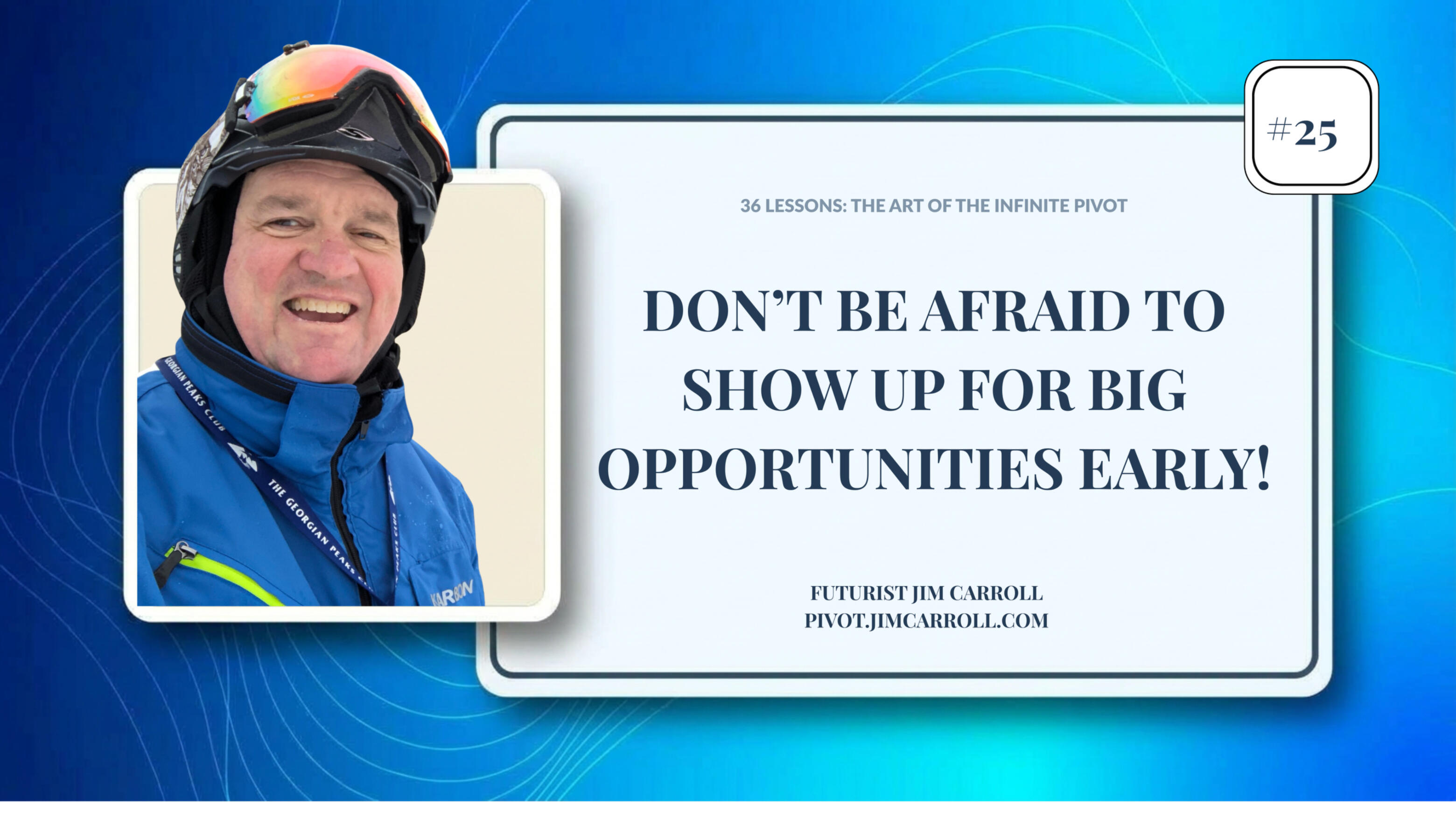
At the ski club, I’m known as the guy who is first at the chairlift most mornings and at the golf course as the first tee guy. For a sound check for my keynotes? If they ask me to be there for a 7 am AV test, I’m there at 655AM. And yes, I’m the guy who is first in line for the flight.Annoying? Maybe.Rewarding? Definitely!
Whether it’s a fresh dump of powder on the slopes or a pristine morning on the Old Course, I’ve long thought that there is a profound advantage to being first. And looking back at my 36-year voyage, it seems I’ve applied this “First Chair” philosophy to every disruptive trend I’ve covered. If you want the best “runs” in the future, you can’t wait for the crowd to wake up; you have to be there when the light is just hitting the snow.Being early isn’t just about speed; it’s about finding opportunity before everyone else does. And that becomes critical to your ability to pivot into a new career or business opportunity.From a skiing metaphor, the Early Mover sees the terrain exactly as it is, before it’s been tracked out, analyzed to death, and smoothed over or turned to crud by the arrival of the masses. The Late Majority arrives when the value has already been lost – they are skiing in everyone else’s ruts.In my career, this meant diving into the Internet in the late 1980s, long before many other people became involved. This meant that when it expoided ontot he scence in 1993, I was already well prepared to be a guide to what it meant. My books and speaking career exploded as a result. Another opportunity? The arrival of open-source technologies and collaborative online communities involving such technology as Linux from the late 1990s, which led to my ability to predict the speed with which new ideas would emerge on new platforms.It meant speaking, writing, and working with new emerging IoT (Internet of Things) technologies as early as 1998, resulting in predictions that came true a decade later. (There was an article about me around that time, titled “Is this guy crazy or just way ahead of his time?” I would go with the latter.)

Disruptive business models and new market entrants? I predicted the Tesla business model and car platform in 2006 in front of a bunch of auto engineers from legacy automotive companies – and they laughed at me. Fast forward, and I was dead right, and they are now losing the future. (I’m now, with confidence, predicting Tesla’s ultimate demise.) AI? I was covering its profound impact as early as 2010, long before it became a boardroom buzzword.If showing up early means showing up at 6 AM to “do the work” while the rest of the world is still hitting snooze, then I’m all in. Most of these Daily Inspiration posts are written during my first moments of clarity after 5 am, coffee in hand, mind abuzz with ideas.Many people fear being “too early” because they worry about looking foolish or standing alone. But the reality might be that it means they miss out on the opportunities that others see.The “Infinite Pivot” requires the stamina to be an early riser. You have to be willing to stand at the lift while no one else is there, because that’s the only way to get the best snow of the day.The fact is, the freshest snow—and the most profound insights—belong to those who refuse to wait.
#26 - "Never put yourself in a position in which you regret what you didn’t do."
Forty-one years ago today, I stepped onto a plane in Halifax, Nova Scotia, heading toward a national office in Toronto, Ontario, and a future that didn’t yet have a name.I was a Chartered Accountant by trade, but my heart was already in the “pipes”—the emerging, messy world of computer connectivity. For three years, I had already immersed myself deep into the opportunities that came from the online world, understanding the power of global collaboration, online research, knowledge acceleration, and disruptive ideas. In my heart and in my mind, I just knew that something big was on the way, and I wanted to be a part of it.
The move came about because I had been identified by the national office as someone who could implement the opportunities of that ‘something big on a nationwide basis. They offered me a position to chase my ideas, albeit in a bigger, well-funded way – and I accepted.That moment in time was the final, terrifying step in my ultimate pivot. I wasn’t just changing roles; I was abandoning “certainty” for a wild risk on what would eventually become the Internet. And yet, I’ve never looked back with regret at the decision I made to move forward. I often wonder what my world would be like today if I had let that regret define my future.41 years on, I know I did the right thing.Many times in your life, you will need to confront similar big decisions. Should you make the big, bold leap? Should you take the daring jump into the unknown? Can you really hold your breath, close your eyes, take the plunge into tomorrow, and hope for the best?If you don’t, you might end up regretting not doing the most important thing you should have done.Never put yourself in that situation.Here’s the truth: regret is far more expensive than failure.Listen to your quiet internal voice. In 1985, when I was casting myself into the unknown, the skeptics were loud, but the voice inside my head that was telling me that global networking would change the world was louder. And wow, was I right! I walked away from a secure corporate ladder because I knew that “staying the course” would cause me to miss out on the opportunities of some of the biggest disruptive ideas of our time.The greatest risk you will ever take is the risk of staying where you are when you know you were meant for what’s next.Forty-one years later, my accounting title is an artifact, but the decision to chase a future without a name remains the smartest move I ever made.Don’t ask what happens if you fail.Ask what happens if you never try at all.
#27 - “The variety of your voyage is your key weapon for regular reinvention.”
Forty-one years ago, I wasn’t a futurist. I was a Chartered Accountant boarding a plane from Halifax to Toronto to chase a future that didn’t yet have a name. I had no clue where my career was going, but I knew I had to get there!Without knowing it at that time, I was already in the midst of a voyage that would witness relentless reinvention.Most people think a pivot means starting over. They are wrong. In my voyage, I’ve learned that the Infinite Pivot is actually powered by the accumulation of experiences. With every unique career pivot, you aren’t abandoning your past; you are stacking radically different worlds until you become a force that no one can duplicate. My 41-year journey since leaving Halifax wasn’t a single path; it was a series of radical reorientations that required me to shed my old skin to survive the next world.
When I look back at “What Got Me Here,” it isn’t a resume of titles; it is a timeline of curiosity, risk, and relentless reinvention. Here are a few of the unique experiences and careers along the way.1976: A factory worker during university, making telephone books.1977: Roadie for KISS and April Wine for a few concerts, as a part time summar job.1977–79: Processing home insulation grants for a government program, both as a summer job and part-time during university.1979–1985: Chartered Accountant — audit, tax, and business advisory.1983–1989: Involved in creating “ThorNet” and “EWiNet,” a pre-Internet corporate knowledge network with 2,600 users in 38 countries.1984: Hosted my first radio program, Micro Minute, a series digging into the emerging implications of computer technology and connectivity1989–1993: An email consultant and competitive intelligence professional.1993: Co-wrote my first book, becoming the co-author of the #1 bestseller, Canadian Internet Handbook.1993–2000: Became a leadershupo ‘guru’, as a frequent speaker on Internet technology and trends.1995: Hosted NetTalk, a national radio show exploring the internet1996: ‘Starred’ in the full-length video, The IBM Family Guide to the Internet, the start and conclusion of my ‘acting’ career1994–2002: Co-Author of 34 more books about the impact of connectivity on finance, investing, healthcare, and business strategy.2003: Formally pivoted to the role of a “Global Futurist” in my speaking and writing.2004: Added to the roster of Washington Speakers Bureau, sharing events with George W. Bush and other luminaries, pivoting to the top of the US speaking industry2004: Authored What I Learned from Frogs in Texas, firmly planting a stake in the ground as an expert on innovation2007: Invited to keynote the U.S. Air Force Research Laboratory to discuss the “acceleration of everything” and the future of R&D, cementing my position in linking future trends and innovation opportunities2009: Spoke to 10,000 at Burger King’s global franchise conference, with Leonard Nimoy (“Spock”), establishing my role in covering future consumer, food, retail, and a broad range of other trends, firmly escaping the ‘technology’ box I was in2017: Invited by the Office of the Prime Minister of the UAE to discuss the future of governance and the impact of the “Acceleration Paradox” on future global economic development, establishing yet another level of deep expertise to my portfolio2025: Wrote Dancing in the Rain, solidifying my position in the leadership topic of resilience2026: Finalized the manuscript for Being Unique, digging deeper into the elements of innovation and creativity.That’s a lot of unique experiences and skills developed along the way!And put that into perspective in terms of your own voyage – I suspect you have a similar list of accumulated experiences (perhaps excluding the KISS angle!) And think about what that means. We are conditioned to believe that a career is a ladder—a straight, predictable climb toward a single destination. But if you want to survive an exponential future, you have to realize that a long-term voyage is actually a portfolio of distinct lives.The “Infinite Pivot” means accepting that you are never “finished.” You are just continually reinventing.In my case, I moved from a factory floor to an accounting firm to a stage because I refused to let my current title define my future potential.Your life and career are a collection of experiences,In that context, don’t be afraid to kill the current version of your career to make room for the next one!
#28 - “You should never wait for the world to catch up to your obsolescence.”
Here’s a truth to consider: your gut feels the pivot long before your head admits it.Sometimes we are forced into a career change or pivot. Other times, we need to make the decision on our own.Either way, it’s a gut-wrenching moment.I know that when I was thinking about leaving the corporate world behind back in 1990, I was pretty miserable. My career track had changed due to a merger; my opportunities vanished; my successful path forward was now in doubt. And yet, I struggled mightily with the idea of moving from career certainty to becoming a self-employed unknown chasing a future that didn’t yet exist.But I went through with it, and it turned out to be the right thing to do.
Here’s what I’ve learned in the decades since: when a pivot is forced on you, you go through something a lot like the stages of grief: shock, denial, anger, and eventually acceptance. When the pivot is your own choice, the same thing happens, just in slow motion. You sit in denial that things have to change. You get angry that they have to. And eventually, hopefully, you accept it.As I wrote in my book Now What? Reinvention and the Role of Optimism in Finding Your New Future, the faster you get to acceptance, the quicker you can reinvent.So how do you get to acceptance? You learn to recognize the signals. Some triggers will tell you when it’s time:
The expiry of your relevance: As I put it in Now What? “We can never dare presume that the skills we have today will carry us forward into tomorrow.” If you feel your current knowledge is becoming a relic, you are already standing on the edge of a pivot. It’s time for something new.
The “soul-crushing” signal: If your current work lacks meaning, you are “under-meaning,” for lack of a better phrase, not just overworked. Reinvention is about reclaiming your life, not just your paycheck. It’s time to pivot.
The need for reinvention velocity: As I explored in Now What?, we are often caught between our inability to get started and our internal desire to grow. Optimism is what bridges that gap — what I call reinvention velocity. Or, borrowing the spirit of a Bob Seger lyric: “…we cannot be denied the fire inside…” When you sense that gap closing — when the desire to move starts to outweigh the comfort of staying — that’s a trigger.
The “Sunday night” signal: When dread of the week coming becomes a recurring pattern, not an occasional bad mood, it’s probably time to move on.
And one trigger that sits apart from the rest: if you are drowning your career misery in substance abuse, the pivot question has already answered itself. The first move isn’t a career change. It’s getting help, from yourself or from someone trained to give it. The pivot comes after.Here’s the filter, though: not every bad week is a signal. Burnout, a difficult client, a rough quarter — those are weather, not climate. The triggers above only matter when they become persistent, structural, and patterned. If a vacation fixes it, it wasn’t a pivot signal.If you’re a knowledge worker right now, you’re probably feeling at least one of these triggers. AI is collapsing the half-life of professional relevance from years to months. Most people are still stuck in the denial stage, telling themselves their role is safe, that the technology is overhyped, that they have plenty of time. The thing is, maybe they (we) don’t. The question isn’t whether your (my) role will change. It’s whether you’ll lead the pivot or get pushed into one.What we do know is this: you should never wait for the world to catch up to your obsolescence. You should never wait to move on from your current circumstances until it’s “too late.”You should never find yourself thinking “I should have jumped sooner.”Because when you wonder if it’s time to pivot, it probably already is.
#29 - “Every ‘no’ is a vote for a future ‘yes.'”
In the global freelance economy, the pressure is relentless: take everything that comes through the door. Chase every lead. Never leave money on the table. Never turn down an opportunity.Hustle.I get it.I've lived that reality since 1990.Here's the thing - the tone for the hustle is set right out of the gate. When you're in year one of running your own thing, every email feels like the difference between making it or not. You say yes to almost anything because the alternative of an empty calendar is terrifying. I've lived that reality for a long time. My early years on my own were a frantic hustle of saying yes to anything that looked like it might pay the bills.
But here is what I've learned in the 36 years since: the pivots that worked weren't built on the things I said yes to; sometimes, they were built on the things I said no to.Every no is a vote for a future yes.Think about that. Any time you take on the wrong client, the wrong topic, or the wrong project, you don't just lose that day or that week. You risk losing that time for something that could have been used for something better. You fill your calendar with mediocrity, and then you wonder why the perfect opportunity passed you by. It passed you by because you were too busy doing something else.From 1998 to 2001, I was doing, perhaps, 80 to 100 events per year. 4 keynotes in 4 days in 4 different cities all across North America. Travel, a full schedule, prep time. It was exhilarating, but at the same time, I was raising a young family with my wife, writing even more books about the Internet, participating in book tours, and so much more. And when the dot.com collapse happened in 2001, I was not quite prepared to reinvent - to pivot - at the speed the future demanded. It wasn't until 2004 that I finished writing my book, What I Learned from Frogs in Texas: How to Save Your Skin with Forward Thinking Innovation, that I was able to escape the tech lable nd move into the innovation/futurist branding.I look back sometimes and realize I lost three years that might have made my pivot to a new future easier. I didn't - because I didn't make time for the necessary pivot, because I was too busy saying yes.I learned a very powerful lesson.It's hard to think about, but ultimately, saying YES to everything will eventually get in the way of your success. You can't move toward a new future if your calendar is jammed with last year's commitments to this year's wrong opportunities. The freelance economy doesn't reward those who say YES most often. It rewards those who say YES most carefully.It's not just that - sometimes, you just should not do the things you might otherwise do, and need to say NO - not to make time, but to protect your brand, reputation, and personal outlook.A few weeks ago, I turned down a tobacco company inquiry. NO. Years back, a client wanted me to take on a topic around cryptocurrency that involved making promises about the technology I knew were unrealistic. NO. (I turned out to be right; the plans the company had involved an area of crypto hype that has flatlined.) Various healthcare events with topics that bordered on fraud? NO.Then there are the opportunities that border the edge of reality - people putting together a shady conference, a proposal that is clearly on shaky ground, or a business initiative that just doesn't smell right. After 36 years on my own, I can usually spot a hustler in the first email: within three sentences, sometimes within the subject line. The radar develops only after you've been wrong enough times to learn what wrong looks like. And once you've got it, you don't ignore it. You say NO.Last but not least, saying NO is critical to manage burnout, which puts you in far worse circumstances. Later in my career, when things were crazy hot, I was turning down 5 to 10 keynote requests a week - or rather, my wife was trying to convince me the schedule was simply too full. How did I learn to finally say no? I burned out. I hit the edge. I paid a price. And yet that was a hard lesson to learn, because for a little while, I didn't listen - I lived for the hustle. The result? For a time, I was a direct casualty of the hustle. (More on that story one day.)In all of this, I haven't even mentioned the importance of saying NO to focus on your health, wellness, fitness, and family. The importance of that should be obvious.Think about all of this this way: in our increasingly complex world, we all need to make time in the hustle to pivot. To prepare for a different future. To reinvent ourselves. To get ready for the next thing. That means you need space to grow, learn, and reskill yourself. This needs a gap in your schedule, a clear hour in your week, an open file in your mind. Every yes you give to the wrong opportunity is a quiet no to the time you should be making in your life.The Infinite Pivot requires you to be ruthless about what you decline.That feels uncomfortable, especially when the inquiry comes with money attached. But here's the test I use: if I say yes to this, what am I quietly saying no to? Because every yes has a hidden cost — the future opportunity you won't have time for, the rest you won't take, the deeper work you won't do, the family time you won't get back.Saying no isn't refusal.It's intelligence.It's the most underrated discipline in the freelance economy.Stop chasing every opportunity.Start protecting your future ones.The time you guard today is the time you will have tomorrow to pivot when you need to.
#30 - “Every ‘no’ is a vote for a future ‘yes.'”
Most failed pivots aren’t pivots to the wrong future.They’re pivots to a future that no longer exists.I’ve been writing about this idea for years, in one form or another. Back in 2022, I framed it this way: “Confront today as it is, not as you want it to be, but face tomorrow as you want it to be, rather than just accepting it for what it might be!” In another post, I put it more bluntly: “Don’t chase the reality you want. Create the reality you can pursue.” I’ve long recognized that when it comes to reinvent yuorself for the next opportunity, you need to adapt to new realities, not existing ones.
Earlier this year, when Mark Carney stood up at Davos and said, “We actively take on the world as it is, not wait around for a world we wish to be,” he was saying the same thing. I knew immediately why that line landed globally and drew so much attention. He’s repeating this idea everywhere he goes, stating it again pretty clearly at a global summit in Armenia. The dude must be following me. (-;And yet, it captured something most leaders, most companies, and most individuals quietly refuse to do.They want to pivot, but only to a future they already imagined.They want the past to come back, just rearranged.They want their old career, with a fresh coat of paint.That’s not a pivot.That’s nostalgia in a different outfit.Here’s what I’ve learned the hard way: the future will not negotiate with your desires and wants. It doesn’t care about your plans, your nostalgia, your investment in who you used to be. The future shows up as it is, sometimes brutal, sometimes accelerated, and often inconvenient.You either align with it, or you don’t.I learned this most clearly through my own recent recovery. When I fractured my spine in three places, I had a choice. I could spend my recovery fighting reality, mourning the activities I’d lost, comparing every day to the day before the injury, trying to engineer my way back to who I used to be. Or I could accept the body I actually had, the timeline I’d actually been given, and the recovery that was actually possible, and engineer toward the version of me that existed on the other side.I chose the latter. Daily cardio, even on the bad days. Heavy lifting at the gym once cleared. AI-assisted analysis of my recovery curve.Slowly, methodically, building the strength required for what came next, not chasing the strength I had before. When I stood on Swilcan Bridge in St. Andrews this past April, I wasn’t the person who had stepped off a chairlift in February. I was someone new.That’s the principle, the idea, the method.In a fast-evolving future, keep in mind you can rarely pivot back to who you were. You pivot to who you’ve become.Here’s the test: when you imagine your pivot, does the destination look a lot like a slightly improved version of your past? If yes, you’re not pivoting. You’re hoping, and hope is not a strategy.The hardest part of any reinvention isn’t the work. It’s letting go of the version of yourself that no longer fits the world you’re in. The injury you’re recovering from. The career that’s no longer there. The industry that’s been rewritten. The skills that have become obsolete.You can’t pivot toward a future you refuse to acknowledge. You can’t recover from a body that no longer exists. You can’t reinvent a market that’s already gone.Take on the future as it is. Work towards the outcome from where you actually are. Build the strength required for what’s next, not the strength you used to have.Because the only pivot that ever works is the one made from reality.
Want to follow the series?
It's a daily email, right to your inbox!
© Futurist Jim Carroll 2026. Contact
Thank you!
You've been subscribed!
Contact Jim!
Message Sent
He'll get back to you as soon as he can!